Universe is expanding up to 9% faster than we thought, say scientists
Measurements taken by Hubble space telescope conflict with studies of radiation left over from Big Bang – fuelling theories of ‘dark energy’ and mystery particles
 Earth and stars as seen from the International Space Station, 17 May 2016. Photograph: Nasa/Rex/Shutterstock
Tim Radford
Friday 3 June 2016 13.34 BST
Share on LinkedIn
Share on Google+
Shares
2,768
Comments1,345
Save for later
The universe is expanding faster than anyone had previously measured or calculated from theory. This is a discovery that could test part of Albert Einstein’s theory of relativity, a pillar of cosmology that has withstood challenges for a century.
Nasa and the European Space Agency jointly announced the universe is expanding 5% to 9% faster than predicted, a finding they reached after using theHubble space telescope to measure the distance to stars in 19 galaxies beyond theMilky Way.
The rate of expansion did not match predictions based on measurements of radiation left over from the Big Bang that gave rise to the known universe 13.8bn years ago.

Milky weigh: our galaxy has the mass of 700bn suns, say scientists
Read more
Physicist and lead author Adam Riess said: “You start at two ends, and you expect to meet in the middle if all of your drawings are right and your measurements are right.
“But now the ends are not quite meeting in the middle and we want to know why.”
The researchers arrived at a new expansion rate of 73.2 kilometres per second per megaparsec. A megaparsec is 3.26 million light years. The consequence of this adjustment in difficult-to-imagine speeds over unthinkable distances is that the distance between cosmic objects will double in another 9.8 billion years. The catch is that such speeds do not match predictions for an expansion rate from other observations made by Nasa’s Wilkinson microwave anisotropy Probe, or the European Space Agency’s Planck satellite. Both went into orbit to study the afterglow of the Big Bang, in which time, space and matter were created. And both delivered lower – and in each case slightly different – predictions for cosmic expansion, the first 5% and the second 9% lower.
The latest discovery also stirs hypotheses about what fills the 95% of the cosmos that emits no light and no radiation, scientists said on Thursday.
One possibility for the discrepancy is that the universe has unknown subatomic particles, similar to neutrinos, that travel nearly as fast as the speed of light, about 186,000 miles (300,000km) per second.
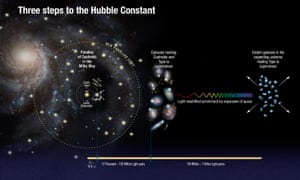
FacebookTwitterPinterest From left: Hubble is used to measure the distances to stars called Cepheid variables. Their brightness means they can be used as cosmic yardsticks to measure distances to galaxies. Astronomers then look for galaxies that contain Cepheids (centre) and Type Ia supernovae, and determine their distance. They then look for supernovae in more remote galaxies. The brightness of distant supernovae are compared to measure out to the distance where the expansion of the universe can be seen (right). Those measurements are compared with how light from the supernovae is stretched by the expansion of space. Illustration: A. Riess (STScI/JHU) and A. Feild (STScI)/NASA/ESA


Sem comentários:
Enviar um comentário