Underwater 'ruins' off Greek island created by bacteria millions of years ago
Site near Zakynthos predates civilization by millions of years and bears striking resemblance to Hellenic structures but is result of process called concretion
 What were thought to be ancient remains of a lost Greek city were in fact created by a naturally occurring microbes. Photograph: University of Athens
Alan Yuhas
@alanyuhas
Friday 3 June 2016 00.00 BSTLast modified on Friday 3 June 201612.23 BST
Share on LinkedIn
Share on Google+
Shares
620
Comments120
Save for later
Columns strewn across the seafloor, detached from their familiar circular bases; tiles as from an ancient Greek courtyard above the water’s reach on an island nearby. A sunken city – or so the snorkelers thought.
Dagger in Tutankhamun's tomb was made with iron from a meteorite
Read more
Greek archaeologists who dove to the site near Alikanas Bay, off the island of Zakynthos, were baffled by the eerie scene they found 7-15ft (2-4 meters) down. Though the sunken debris looked like paved floors and colonnades, the divers could see no other signs of life: no pottery, coins, or shards of sculpture or art.
“They tried to decide whether they’re actually Hellenic stonework,” said Julian Andrews, a professor at the University of East Anglia (UEA) who assisted the research, “but couldn’t find any evidence that it was other than these rather bizarre structures [which] looked like superficially like stonework.”
In fact, the site predates civilization entirely. The “ruins” were created as long as 3m years before mankind is thought to have left Africa – 5m years before Troy, Athens or Alexander.
Microbes did it.
In a study published on Thursday by a joint team from the University of Athens and UEA, the researchers write that the site is not a lost city at all, but a natural if strange phenomenon.
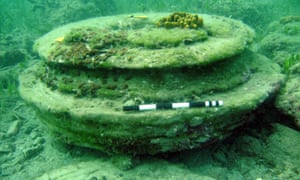
FacebookTwitterPinterest Not the base of a column. Photograph: University of Athens
The team used microscopy and x-rays to study the mineral content and texture of the formations. They found that methane had jetted, oozed and flowed from within the earth, through a subsurface fault still hidden by the seabed.
Advertisement
“The earth’s crust is a rather leaky reservoir,” Andrews said. “It’s almost like a kind of plumbing system, if you


Sem comentários:
Enviar um comentário