Barack Obama: 'Change is going to happen in Cuba'
2 hours ago
From the sectionLatin America & Caribbean
Jump media player
Media player help
Out of media player. Press enter to return or tab to continue.Media captionLive: Barack Obama and Raul Castro make statements in Havana, Cuba
President Barack Obama is in Cuba for a historic three-day visit to the island and talks with its communist leader.
He is the first sitting US president to visit since the 1959 revolution, which heralded decades of hostility between the two countries.
Mr Obama said change would happen in Cuba and that Cuban President Raul Castro understood that.
The two leaders are meeting to talk about trade and are scheduled to hold a joint news conference.
Latest updates of Obama's visit
In pictures: Obama in Cuba
Fidel followers remain nervous of thaw
Six sticking points to better relations
Cuba's DIY economy
How times are changing in Havana
Why is the visit groundbreaking?
For a US president to touch down at Jose Marti airport in Havana and be warmly greeted by Cuban's foreign minister was until recently unthinkable.
Jump media player
Media player help
Out of media player. Press enter to return or tab to continue.Media captionPresident Obama's visit is the high point of a recent easing of ties, which included the opening of embassies last year.
For decades, the US and Cuba were engaged in a bitter stand-off, triggered by the overthrow of US-backed Cuban dictator Fulgencio Batista by Communist leader Fidel Castro in 1959.
The US broke off diplomatic relations and imposed a trade embargo.
But President Obama undertook two years of secret talks which led to the announcement in December 2014 that the two countries would restore diplomatic relations.
Since then, there have been a series of symbolic moments, such as the first formal meeting of Presidents Obama and Castro at a regional summit in Panama and the opening of embassies in Havana and Washington DC.
What have been the highlights of the visit so far?
Presidents Obama and Castro shook hands at the Palace of the Revolution in Havana ahead of their bilateral meeting on Monday.
They seemed visibly more relaxed than at their first official meeting at a regional summit in Panama just under a year ago and smiled broadly.
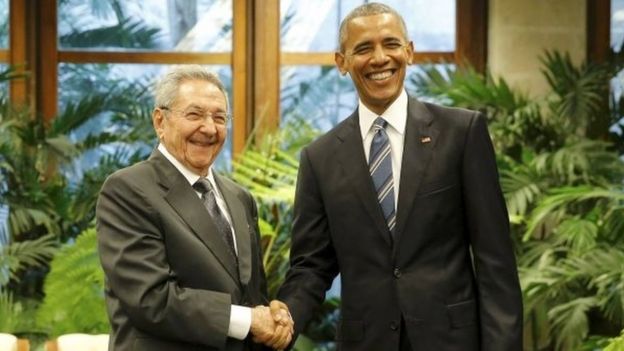 Image copyrightReutersImage captionThe leaders smiled broadly and appeared to be relaxed
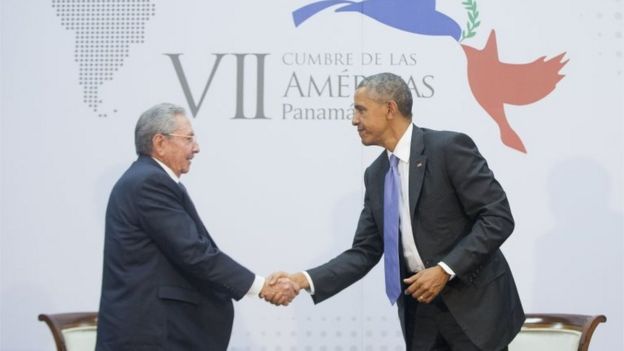 Image copyrightAPImage captionWhen they met last year in Panama the body language was much more reserved
Following his arrival on Sunday, the first stop on President Obama's tour had been the newly re-opened US embassy in Havana, where he told staff it was "wonderful to be here".
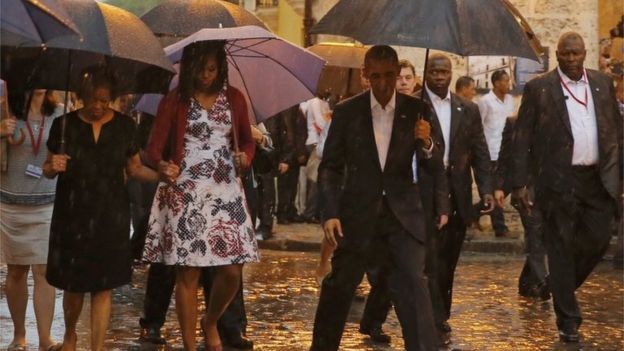 Image copyrightReutersImage captionThe Obama family braved the rain in Old Havana
But it was the visit to Havana's old town which brought home the long way US-Cuban relations have come since the thaw was announced 15 months ago.
While the plan to interact with Cubans in the streets was disrupted by a tropical storm, the image of the US president and his family braving the rain demonstrated to many Cubans his commitment to the new, warmer relationship.
What else is in store?
President Obama is due to get down to the nitty gritty of politics in a face-to-face meeting with Cuban leader Raul Castro.
Their meeting at the Palace of the Revolution will be closely scrutinised for signs of how much practical progress has been made.
Ahead of the meeting, President Obama said he believed that "change is going to happen here and I think that Raul Castro understands that".
He also told US broadcaster ABC that he would be announcing that Google had made a deal with the Cuban authorities to expand Cuba's poor wi-fi and broadband access.
Internet access still restricted in Cuba
There have been a series of other agreements between the two countries since the thaw was announced, including commercial deals on telecoms and a scheduled airline service, increased co-operation on law enforcement and environmental protection.
Many Cubans are hoping their economy will receive a further boost from further openness and reforms as well as US investment.


Sem comentários:
Enviar um comentário