Inside Mosul: What's life like under Islamic State?
2 hours ago
From the sectionMiddle East
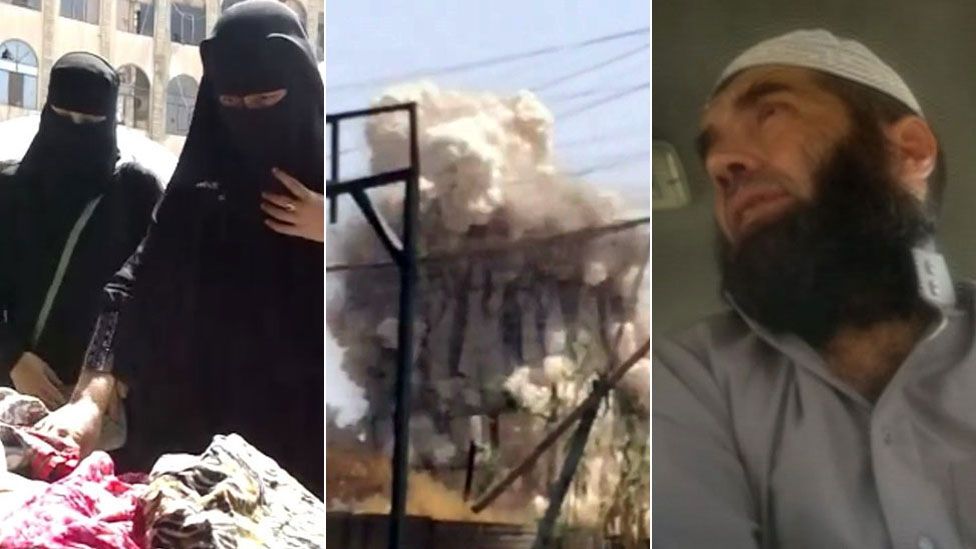
Exclusive footage reveals how Islamic State wields power over people's everyday lives in Iraq's second city, Mosul, a year after it was captured.
Secretly filmed videos obtained by the BBC's Ghadi Sary show mosques being blown up, abandoned schools, and women being forced to cover up their bodies.
Residents said they were living in fear of punishment according to the group's extreme interpretation of Islamic law.
They also described IS preparations for an expected government offensive.
The fall of Mosul marked the start of a lightning advance across the north that saw the army routed and hundreds of thousands of people forced to flee their homes.
1. Control of women
The videos, filmed over several months last year, reveal the reality of life under IS. The first series shows how women are forced to cover up, with one woman challenged for not having her hands fully covered.
Woman chastised over lack of glovesNineveh StreetMosulBaghdadIS controlIS supportIRAQSYRIAKURDISH-GOVERNEDAREASMosul
Jump media player
Media player help
Out of media player. Press enter to return or tab to continue.Media captionWomen are forced to cover up entirely
Hanaa: "IS is very strict about the dress code for women. Women have to be fully covered up in black, head to toe.
"One day I felt so bored at home that I asked my husband to take me out, even if I had to wear the full khimar [a long, cape-like veil that covers the hair, neck and shoulders completely, but leaves the face clear]. I had not left home since IS took over the city. As I was preparing, he told me I would be forced to put on a niqab [veil for the face]. I was shocked at this and considered staying at home for a moment, but eventually I relented.
I saw a father searching for his daughter, who was concealed in a sea of blacknessHanaa
"We went to a nice restaurant by the river we used to frequent during our engagement. As soon as we sat down, my husband told me that I could finally reveal my face as there was no IS presence and the restaurant was a place for families.
"I was very happy to oblige and so I revealed my face with a large smile. Instantly, the restaurant's owner came over begging my husband to ask me to hide it again because Islamic State fighters made surprise inspection visits and he would be flogged if they saw me like that.
"We had heard stories of men being flogged because their wives didn't put their gloves on. Another woman's parents were banned from driving their car. Those who objected would be beaten and humiliated.
"We complied with the owner's request. I started wondering about how ignorant and merciless the state of affairs had become. As we left the restaurant, I saw a father searching for his daughter, who was concealed in a sea of blackness."
2. Persecution of minorities
The footage, which was passed from house to house before being smuggled out of the city, reveals how homes belonging to Mosul's ethnic and religious minority communities have been confiscated by Islamic State. Many residential areas once popular with minorities now stand empty.
Christian homes marked with 'N'ArabiMosulBaghdadIS controlIS supportIRAQSYRIAKURDISH-GOVERNEDAREASMosul
Jump media player
Media player help
Out of media player. Press enter to return or tab to continue.Media captionMany Christian neighbourhoods are now empty
Mariam, a gynaecologist who is a Christian: "I'm known to be an avid reader and own a large collection of books. My collection kept on growing as friends and family leaving Iraq used to send me their books because they knew I wasn't going to leave and that I would take care of them.
I escaped with my body unharmed, but my soul remained where I had left it: at home with my booksMariam
"I was threatened and harassed [by Sunni extremists] before the capture of Mosul, but I kept on delivering babies for women from all religions and sects. I never differentiate between my patients as I believe everyone deserves equal care.
"However, I had to flee as Mosul fell. I escaped with my body unharmed, but my soul remained where I had left it: at home with my books.
"After moving to Irbil [in Iraq's Kurdistan region] I received shocking news: Islamic State had confiscated my house and marked it with the letter 'N' [for Nasrani - a word used by IS to refer to Christians]. I immediately telephoned my friends in Mosul and begged them to save my books.
"But it was too late. They called back saying my library had been emptied onto the street. However, some of my neighbours were able to rescue some precious books that remain hidden."
3. Intimidation, punishment and torture
Clips also show mosques and shrines being destroyed. Residents speak of brutal punishments for anyone contravening the jihadists' interpretation of Islamic law, which is imposed across the "caliphate" whose creation they proclaimed weeks after seizing Mosul.
Yahya Abu al-Qassim shrineNabi Jirjis mosqueNabi Yunus mosqueMosulBaghdadIS controlIS supportIRAQSYRIAKURDISH-GOVERNEDAREASMosul
Jump media player
Media player help
Out of media player. Press enter to return or tab to continue.Media captionIS militants have blown up mosques and shrines
Zaid: "Since IS took the city, it has been applying the 'Laws of the Caliphate', as it calls them. The minimum punishment is flogging, which is applied for things like smoking a cigarette.
"Theft is punished by amputating a hand, adultery by men by throwing the offender from a high building, and adultery by women by stoning to death. The punishments are carried out in public to intimidate people, who are often forced to watch.
They tortured me... The guy who did it wouldn't stop unless he got tiredFouad
"I know many people who have been arrested by IS. Some of them are my relatives. Some were killed because they were in the security services. Others have been released. They tell unimaginable stories of atrocities committed by IS in its prisons.
"Many who come out prefer not to speak. They stay silent, because they're terrified that if they speak, they'll be rearrested."
Fouad: "I was arrested by IS. They came to our family home looking for my brother. When they couldn't find him, they decided to take me to prison instead.
"Then they tortured me. The guy who did it wouldn't stop unless he got tired. He was edgy all the time and he wouldn't listen to what his prisoners said. He flogged me with a power cable and also tortured me psychologically.
"When my brother handed himself in, they found out that the accusations against him were false but they still kept me in prison until they judged me well enough to leave.
"They had hit me so hard with the cable that the marks are still visible on my back."


Sem comentários:
Enviar um comentário