New evidence of Viking life in America?
1 April 2016
From the sectionMagazine
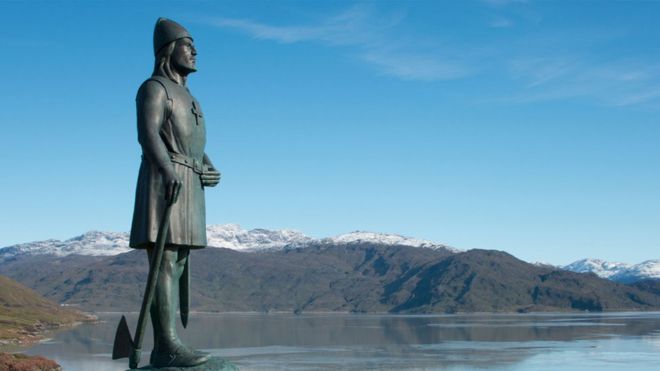 Image copyrightAlamy
In today's Magazine
10 stories that look like April Fools but aren't
Quiz of the week's news
Finnish clubs cry foul over crowd rules
A new discovery has revealed that the Vikings may have travelled hundreds of miles further into North America than previously thought. It's well known that they reached the tip of the continent more than 1,000 years ago, but the full extent of their exploration has remained a mystery, writes historian Dan Snow.
After a long hike across boggy ground and through thick pine forests, clutching pepper spray to protect against bear attacks, Sarah Parcak and her small team of archaeologists stood on an exposed, wind-blasted headland in North America.
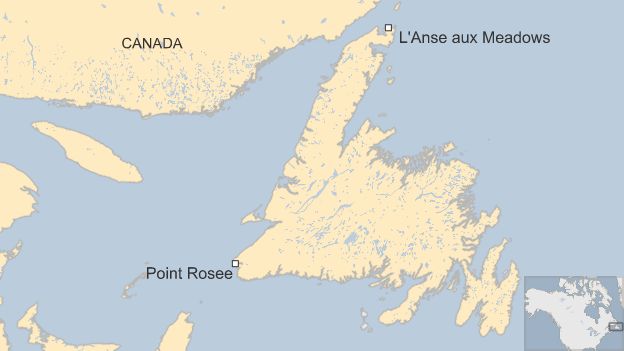
Exhausted but happy, they had been led to Point Rosee in Newfoundland by the most high-tech weaponry in the modern archaeological arsenal - satellite data captured 383 miles (600km) above the Earth. But once here they were back to using trowels and brushes. I joined them to see how this powerful combination of new and old allowed them to make what could be a seismic discovery.
We were here on the trail of one of the greatest maritime cultures of all time. We were here inspired by ancient chronicles which many have written off as fairy stories. We were here looking for Vikings.
Jump media player
Media player help
Out of media player. Press enter to return or tab to continue.Media captionSarah Parcak and Douglas Bolender show Dan Snow what they've found

In about 800AD Britain felt the fury of these men from the north. Portmahomack was one of Scotland's most prosperous and important communities. On a protected bay in Easter Ross, on the edge of the Highlands, it was well placed as a waypoint for merchants, travellers and pilgrims moving along the east coast.
Recent excavations have given us a picture of a wealthy monastery at its heart. Scriptures were copied on to carefully prepared animal skin parchment by monks, skilled craftsmen created beautiful, jewel-encrusted religious ornaments, sculptors carved intricate Celtic crosses. Trade was the source of these riches, the sea brought wealth, but the sea also brought destruction.
Archaeologists have revealed that Portmahomack was suddenly and utterly destroyed. They found smashed fragments of sculptures mingled with the ashes of torched buildings. The settlement was wiped out. It is impossible to be certain but historians now think the most likely explanation is that it was attacked and looted. When I visited, a couple of months before the trip to Point Rosee, I held a piece of skull in my hand, presumably from a monk.
 Image copyrightDan Snow
It had been shattered by a mighty blow, the sword's blade left a deep gouge that makes the cause of death clear. Who were these men who slaughtered God's servants and annihilated one of the oldest Christian sites in Britain? Almost certainly they were men who cared nothing for the Christian God, men who came in ships from the north and west, men who sought gold: Vikings.
The attack on Portmahomack is the only Viking raid in Britain for which we have archaeological evidence. Others, such as the attack on Lindisfarne at about the same time, echo only through the reports recorded in chronicles. Together these two violent raids mark the start of an era of attacks from across the North Sea. The Vikings or Norse exploded out of Sweden, Denmark and Norway, using hugely sophisticated navigational skills and shipbuilding technology as they pushed ever further into the wider world.
Vikings conquered Normandy in France - the land of the Northmen - even parts of Italy and the Levant. They also founded Dublin, made deep inroads into England and island-hopped across the North Atlantic. Orkney, Shetland, Fair Isle and Iceland.
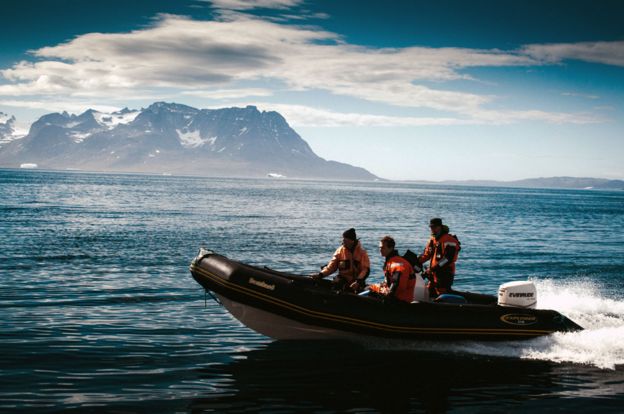 Image copyrightBBC/Freddie Clare
They even crossed to Greenland, where I visited stunning Viking sites on the coast, dodging icebergs to get ashore. But perhaps their greatest achievement is the one shrouded in the most mystery. Did they get to North America? If so, was it a fleeting visit or did they colonise that distant coast too, centuries before Christopher Columbus?
The descendants of the Vikings left sagas - beautiful works of literature in which fact and fiction are often poetically intermixed. They clearly state that the intrepid Leif Erikson led an expedition to the east coast of North America. They describe good harbours, and an abundance of natural resources. One of the most fascinating mysteries in history is whether these can be believed.
Find out more
 Image copyrightBBC/Freddie Clare
In The Vikings Uncovered Dan Snow tracks their expansion west, first as raiders and then as settlers and traders. He travels through Britain, to Iceland, Greenland and Canada to see what could be the most westerly Viking settlement ever discovered. The programme will be on BBC One on Monday 4 April at 20:30.
In 1960, a site on the very northernmost tip of Newfoundland in Canada, L'Anse aux Meadows, was investigated and archaeologists were convinced that it was a Viking settlement. The world woke up to the fact that the Vikings had reached North America before any other Europeans. But no other site has been identified, the search for Viking America stalled. Until now.
Sarah Parcak uses satellite imagery to look for irregularities in the soil, potentially caused by man-made structures which lie beneath. She has used this technique to find ancient sites in Egypt and a few years ago she scoured the Roman Empire where she identified the site of the great lighthouse at Portus near Rome and several other buildings, from a fort in Tunisia to ramparts in Romania. Last year, she decided to search for the Vikings.
It wasn't easy. They travelled light and left nothing behind. No massive stone theatres for them. They voyaged in longships with a strong oak keel, and thin overlapping planks fanning out to form the iconic, graceful hull - the gaps between the planks stuffed with animal hair and tar. The rudder was fixed on with a twisted birch sapling. Sails spun from wool. Food was pickled herring, lamb smoked using reindeer droppings, fermented salmon. Almost everything on a Viking ship would get recycled or rot away. But they did leave a trace, and Parcak's team were determined to pick it up, however faint.
 Image copyrightImage © 2016 DigitalGlobe Inc
They scanned satellite pictures from across the east coast of America. Several sites appeared worth following up, but they had to decide on one for a dig. In the end they opted for a headland, almost the very western tip of Newfoundland, 400 miles further south and west than the only known Viking site in North America.
It overlooked two bays, offering protection for ships from any wind direction. Parcak saw oddities in the soil that stood out - patterns and discolourations that suggested artificial, man-made structures, possibly even Viking longhouses, once stood there.


Sem comentários:
Enviar um comentário