Migrant crisis: Greece starts deportations to Turkey
54 minutes ago
From the sectionEurope
Jump media player
Media player help
Out of media player. Press enter to return or tab to continue.Media captionThe first buses carrying people being returned to Turkey arrive at the port of Lesbos, Greece
Migrant crisis
EU-Turkey migrant deal: A Herculean task
Turkey has European Union over a barrel
The tricky business of solving Europe's migrant crisis
EU migration: Crisis in seven charts
The first boat carrying migrants being deported from Greece has arrived in Turkey as part of an EU plan aimed at easing mass migration to Europe.
Scores of migrants boarded ferries on the Greek island of Lesbos and arrived in Dikili, westernTurkey.
Frontex, the EU's border agency, told the BBC that most of the 136 people who left Lesbos on Monday were Pakistanis.
Meanwhile, the first group of 16 Syrian migrants has arrived in Germany from Turkey, officials say.
Under the deal, for each Syrian migrant returned to Turkey, the EU is due to take in another Syrian who has made a legitimate request.
However, Greek authorities said the first deportees were those who had not applied for asylum, and included citizens from Bangladesh, Sri Lanka and Morocco.
And Turkey's EU Affairs Minister Volkan Bozkir said there were no Syrians among the first group of migrants sent from Greece.
Another ferry carrying migrants to Turkey is also due to leave the Greek island of Chios on Monday.
The returns were carried out calmly, despite a small protest at the gate of Lesbos port, where activists shouted 'No to deportations' and 'EU shame on you', the BBC's Sarah Rainsford at the scene said.
Migrants await fate on Lesbos
EU-Turkey deal a 'Herculean task'
The crisis in seven charts
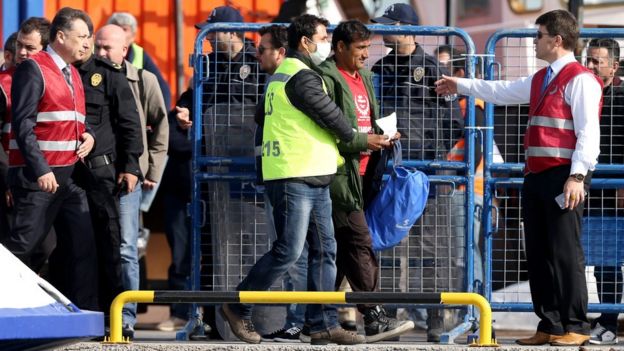 Image copyrightEPAImage captionFirst group of returned migrants were welcomed by Turkish officials in Dikili
Under the EU-Turkey deal, migrants arriving illegally in Greece are expected to be sent back to Turkey if they do not apply for asylum or if their claim is rejected.
But migrants in Greece have complained of a lack of information about the asylum procedure and some said they were unaware they could be returned.
Frontex has less than one-tenth of the staff needed to do the job, the Associated Press reported.
At the scene: Mark Lowen, BBC News, western Turkey
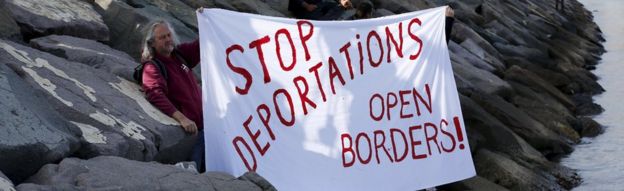 Image copyrightReuters
Both Turkey and Greece have made a panicked rush to meet this deadline - and neither country is really ready.
Only a fraction of the necessary staff have arrived on the Greek islands to accompany the process and in Turkey the preparation is still sketchy.
Two tents have been erected in Dikili to register the first group from Lesbos, with similar facilities further south to receive migrants sent from Chios.
The Turkish interior minister says non-Syrians will be deported while Syrians will be sent to refugee camps where they will replace those who will be directly resettled in Europe as part of the "one for one" plan.
But there are still grave doubts over whether the deal will hold and if the migrants will be properly treated when they arrive here.
The arrangement has alarmed rights groups, who say Turkey is not a safe country for migrants.
Amnesty International has accused Turkey of illegally returning Syrians to their homeland, something Turkey denies.
Save the Children called the deal "illegal and inhumane", saying people told them they would kill themselves if sent back to Turkey.
Migrant arrivals to Greece
150,703
in 2016, up to 30 March
37% of 2016 arrivals are children
53% arrive on Lesbos
366 died on Turkey-Greece route
853,650 arrivals in 2015
Source: IOM
Getty Images
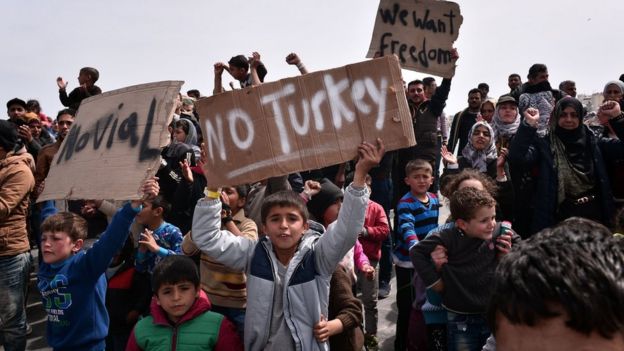 Image copyrightAFPImage captionMigrants on the Greek island of Chios have protested against the deal
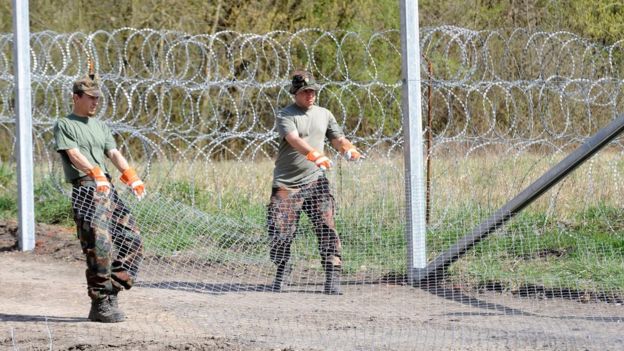 Image copyrightEPAImage captionBorder controls further north, like here in Hungary, have left thousands stranded in Greece


Sem comentários:
Enviar um comentário